


Review: The Great Clown Bank Show
Updated: Jul 26
Send in the clowns…don’t hurry they’re here.
Immersive Scene Los Angeles 2026 Review

In an era when America’s top one percent holds 30-35% of the wealth — roughly double the share in the 1980s when Gordon Gekko famously proclaimed “Greed is good” — the timing for a show indicting and skewering the new monopoly-men of the day couldn’t be riper. With the likes of Musk, Zuckerberg, Trump and others putting a face on the franchise, the rest of America is left wondering how the cash circus got this big, and whether we might get just a little popcorn money ourselves. So, societally speaking, the table is perfectly set for a would-be spectacle like The Great Clown Bank Show. Let’s eat the rich…right? Well, not quite, in this theatrical-circus-satire-with-music now wrapping up its run at the Open Fist Theatre in L.A.
Welcome to the Big Top, ideal metaphor for all of the excesses of our day, and where clown-faced and pant-less immigrant Gus Greedy (Davis Barber) arrives in his pursuit of the almighty dollar. In no time, he’s chosen his first power-suit and identified the business he’ll build his moolah mountain upon: banking. His scheme for getting filthy rich is pretty simple: he’ll offer his suckers, er, customers at his Clown Bank a measly 0.3% interest on their money. He’ll lend too, but only at exorbitant interest rates, then reinvest that money to make huge profits, while nickel and diming his victims, I mean, valued clients, for everything from ATM fees, to check fees, to fees for walking through the door. For the coup de grace, he’ll manipulate the entire system so that he doesn’t have to pay any taxes. As a clown himself – full makeup applied – he’ll do it all with a smarmy smile and the assistance of his equally conniving wife, Glenda Greedy (Clara York). He’ll need lieutenants too, so they soon produce a couple of greedy sons, Gary (Matthew Goodrich) and Glenn (Kevin M. Brennan), who help to keep the cash rolling in between their constant bickering while competing for the hand of social climber Greta Garrotte (Elle Engelman), soon to be Greedy. Soon, granddaughter Grizz (Tambrie Allsup), who has an eye for the dough and the ladies. joins the circus, while her twin brother Griffin seems the only Greedy with a pulse of conscience — if he can just find it under all that cash. Power family in place, the Greedys build their hall of shame to the highest heights, rewarding themselves with all of the mini cars and whipped-cream pies they desire, laughing all the way to their bank and sending a big “f*ck you” to anyone who gets in their way.
This whole greedy circus takes place literally in a circus ring - emceed by The Ringmaster (Hank Jacobs), introducing the clown-faced family and the various acts they exploit, including a terrified aerialist (Avery Shannon Lynch) and some burlesque dancers the Greedys keep around for their personal enjoyment. The three-ring-get-rich scheme only grows bigger and brasher through song, dance, magic, cheating, lost-love and a lot of compounding interest, until, inevitably, the entire Greedy enterprise comes crashing down under the weight of its own excess.

Our hopes for this timely comedy were high, especially after a delightful pre-show immersive experience that included a wonderful outdoor stilt walker, the Open Fist’s lobby transformed into an interactive circus midway with games of chance, popcorn station, costumes to try on, and clown-themed ephemera everywhere. The zany Clown Bank ATM worked fine just as long as you weren’t requesting a withdrawal. Even the bathroom had an old Victrola playing clown-affirmations… “I’m a clown and I have big shoes to fill.” At entrance, audience members received $150 in clown money to spend on the midway and had been assigned clown names; I lucked out with Zippy McNoodleboots. It was all fun, charming, mood setting and suggested a great time ahead.
Inside the tent, though, the show’s challenges became clearer. After a promising first fifteen minutes — including a clever tycoon-dress-for-success sequence and a fun visual bit showing wealth building from bank to house to mansion to empire — the momentum fades quickly. The concept of framing a satire about greedy capitalist clowns in a literal circus-environment is enticingly strong, but the story never deepens enough to keep it involving. Once “greed is bad” is established, the satire stays much in the same place. A narrative shift is called for but never transpires. Griffin’s brief flirtation with love and possible moral awakening presented that chance, but it’s abandoned as quickly as it’s introduced. What remains is an intriguing idea, but underdeveloped execution that could blossom with further workshopping. Other shows like Candide in the 50’s and Bloody Bloody Andrew Jackson, a half-century later, have successfully blended farce, music, social commentary, and clowning (even real clowns in Carnival) – but they had weightier material to sustain their success, something this piece still needs and could find with further development.
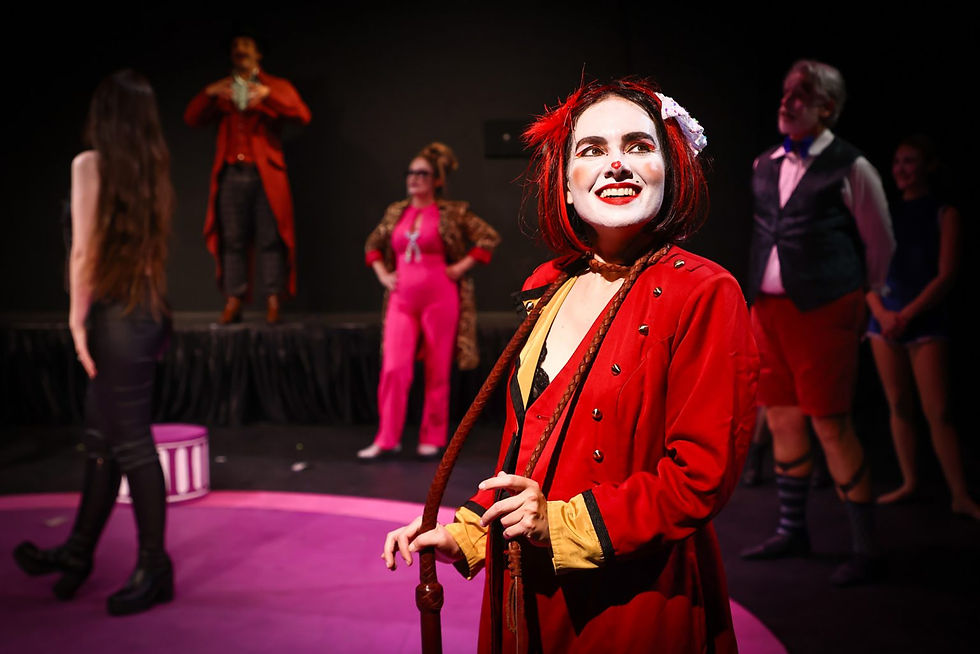
Still, there are several bright spots along the way, led by the fine comedic performances of Goodrich and Brennan as the arguing-from-birth siblings, a standout vocal number by the show’s strongest singer, Amiee Conn, Engelman’s nice turn as the “I always wanted to marry rich” Greta, and lively choreography by Raquis Petree. There’s also a lovely second-act courtship dance (“Gaslighter’s Waltz”) with Lynch and Kelly that hints at deeper layers the show might explore more fully in future iterations. The minimalist yet effective Big Top set by Jeremy Thompson feels like a real circus and sets the mood. And those immersive entrance-midway designs by DJ Hand-Crank were an early treat.
Some production choices were uneven and didn’t fare nearly as well, including limited clowning skills from several in the cast. This is clowning, not playing a clown with big floppy shoes, and the artform was only showcased at a high-level by two or three in the cast, most notably Bethany Koulias, particularly in one of her roles as Dr. Clownman.
The interwoven circus acts themselves might have helped raise the bar had the creative team included some higher-quality Big Top routines. Aside from a cool but not-too-high aerial ring display by Lynch, there’s not much to entice. One or two premium circus acts would have added a lot here, but we’re only left with a tepid knife-throwing gag, a fake sword swallower routine and the guest magician storytelling act that feels flat and forced into the narrative.

Creator Hank Jacobs piled his plate high as writer, director, producer and actor in this music-driven show, even penning the lyrics for Mike Messer’s song creations. It’s an ambitious load. Jacobs’ love of circus is evident, and his Brechtian performance as the Ringmaster/narrator is engaging, but a few of his directorial choices were confusing – particularly a mid-show birth scene and baby-fever dream sequence – that suggested the show was shifting from broad farce to theatre of the ridiculous midstream. It was absurd in the wrong way. Luckily, Koulias and the clown nurses (Conn and Carmella Jenkins) helped save the former.
Jacobs also opted for a range of clown makeup for his cast, from full on to barely there, which created an uneven visual language. Most in the ensemble were up to their roles, though a couple of pivotal casting choices didn’t work, particularly in the singing department. Story-wise, a late and bizarre twist involving a Crocodile Dundee-like character swooping in for an affair with Glenda didn’t help. The big musical finale “LFG”(Let’s F*cking Go”) kind of said it all. Could it all have been just an off night? Hard to know, but recurring upstage audio issues and a small crowd size didn’t help the energy or improve the chances for a stronger outcome.
There’s enough potential in The Great Clown Bank Show to suggest there’s something more yet unrealized here. At present, the music is pleasant but not memorable, some staging choices confuse more than clarify, and a couple of key roles need stronger stage presences. Most importantly, though, it’s about the story, and this one still needs further shaping. With deeper writing and a more defined emotional anchor, the show could evolve into a sharper, more resonant satire. Right now, the message never fully lands, and trying to meld clowning, capitalism satire, and absurdist buffoonery without a strong and sustaining narrative spine proves too heavy a lift.
Credit to Jacobs for not steering this into a political parody, which would have been an all-too easy choice in today’s world but was wisely avoided. The parallels with real life clowns were clear enough. Yes, the bad guys won at the end, which might be all too true in real life sometimes, but in theatre we need someone good to root for, someone to prevail. If only Griffin hadn’t let his love slip away so easily, the show might have found that anchor right there.
by Thom Mills for Immersive Scene Los Angeles
Open Fist Theatre Company
Atwater Village Theatre
3269 Casitas Ave.,
Los Angeles, CA 90039
runs thru August 1, 2026
tickets: $22.75-$35.25


