Review: Wicked Lit 2026: La Llorona and The Headless Horseman
Updated: Nov 1
One a haunting tale of lost heads, the other of lost minds: Both brilliant
An Immersive Scene Los Angeles review

If you wanted to be dramatic, and I do for just a moment, you could call it Criminal! (with a capital “C” and an exclamation point). Criminal, in that a theatrical production of this impact and near perfection in writing, staging, and acting is only playing a far-too-brief run of just five nights. This means only a relative few will get to witness one of the finest small-stage presentations to play Southern California in years.
The spooky-themed double bill marks the much-anticipated return of Wicked Lit, perhaps the first theatre company to fully commit to putting site-specific immersive on the map in the Los Angeles region. The fan base for the respected group's work is large and loyal and has eagerly awaited its return, and though this rebirth of Lit doesn’t fully qualify as immersive, it is the finest possible example of pure theatre.
But fear not, acolytes, Unbound Productions (the founders of Wicked Lit) haven’t completely abandoned immersion: the pre-show and post-show activities surrounding the two plays offer a few interactive possibilities that reflect back on those good old days, but with a new type of participatory flavor. There’s even a very special surprise guest on hand for diehard Lit fans from the days of The Mountain View Mausoleum where so many of the company’s triumphs were presented. More on that later.
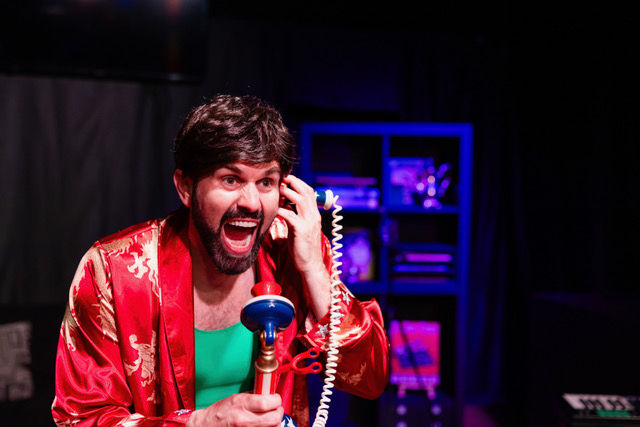
Up first is The Legend of Sleepy Hollow, and we’re introduced to the eerie tale by a sort of spiritual guide for the night, El Diablo (Joe Camareno). We’ve been transported back in time to upstate New York in 1790, where the dandyish and completely smitten new schoolmaster in town, Ichabod Crane (Jake Mouchawar), is determined to win over a beautiful heiress Katrina (Sadie Cowing), after making all efforts to prove to her indifferent father (Jonathon Lamer) that he’s worthy of the young beauty. It’s all for naught of course as Katrina’s other suitor, the dashing Brom (Abel Miramontes), has the clear upper hand throughout, and he’s dear old dad’s choice too. Truth be told, Katrina fancies the latter as much or even more so than poor Ichabod.

Rebuffed on the pivotal night, Ichabod gallops off into the forest only to be chased by the ghostly Headless Horseman through the woods, never to be seen in town again. Was it the ever-searching-for-his-head Hessian soldier who lost his own to a cannonball in the war, as the oft-told superstition goes, or was it merely Crane’s romantic rival, holding aloft a pumpkin replacement for the missing noggin as he chased the frightened schoolmaster away to ensure the foolish boy never set foot anywhere near Sleepy Hollow ever again? You’ll have to decide.
The second show of the dual bill is Las Lloronas, and we now begin in 16th-century Mexico (though we won’t be there for long), where Hernan Cortes (Lamer) takes a lover who soon bears him two children. Once the conqueror has had enough of the country and the Aztec woman, he promptly returns to Spain, leaving her alone, whereupon she tragically kills their children with her hairpins in revenge for being spurned.
Thus begins the legend of the Weeping Woman, but it is only the start, for she reappears again a century later, another Maria entirely, also with two children and again abandoned for another. She too is so distraught that the idea of killing those she bore as insane payback seems the only solution. History will repeat itself again and again and again, all the way to modern-day America, as other tormented mothers continue the diabolical cycle that created the haunting legend so many years ago.
Both plays, enthrallingly adapted by writer/director Jonathan Josephson, hit the bullseye in this inaugural offering from Wicked Lit’s new incarnation. For those who might have worried about a traditional theatre setting versus the former, site-specific, follow-along productions, put those concerns aside. This Wicked Lit is nearly every bit as interesting as its earlier incarnation. It’s different, yes, more traditional theatre for sure, but it retains the quality and intelligence of the Wicked Lit brand in a fresh form. It’s a bridge between the old and the new, and a solid bridge at that.
As you enter the theatre, the cast stands silently shoulder-to shoulder downstage, holding candles. A background of haunting music, combined with deep-blue lighting further establishes the mood. The stage has, literally and figuratively, been set before the first words are spoken.
In the far lighter offering of the pair, The Legend of Sleepy Hollow, Josephson lets his cast have some fun, even as the sinister implications begin to form. It might be a ghost story, as legend would have us believe, or merely the more human story of two suitors battling it out, with one using an old folk tale to help clear the playing field. Whichever it is, it’s cleverly staged and often amusing, especially as we experience the amazing Mouchawar as Ichabod Crane trying his failing best to appear the perfect catch to his love. Channeling the energy and physicality of a young Don Knotts, Mouchawar is a comic actor of note as he does everything in his lanky power to win the girl. Though his Ichabod fails to impress his petulant students or the fair lady, the very appreciative Anaheim audience loved Mouchawar’s attempts and physically comedic style.
As his unrequited love, Katrina, Cowing also shines as she feigns outward innocence, but quite knowingly plays both sides of the romantic fence like a fiddle, leading both Ichabod and his dashing rival Brom, a terrific and terrifically arrogant Abel Miramontes, (who cockily says “you’re welcome” to the audience as he enters before them) toward the inevitable mano-a-mano conflict.
The entire versatile ensemble plays at least two or three roles each, including that of collective storytellers, and brings each character to full realization with a new voice, a shift in body language, or simply a characterful frown turned to a smile. Jessica Schreiber, in one of her many parts over the evening, got maybe the biggest laugh of the night as a stooped-over delivery person. When we finally get a glimpse of the black-caped Horseman himself galloping on his steed, it’s done with a wonderful bit of haunting stagecraft that has the ghost seeming to disappear before our eyes.
This entertaining opener isn’t really a scary adaptation so much as a spookish, intriguing one, and Josephson’s decision to lean into the humor here is a wise move, which deftly sets up the much darker piece yet to come.
Then we witness a La Llorona like none other I’ve seen, and make that Las Lloronas with an “s,” as in plural, because this is no longer a folkloric tale of only one unimaginable killing set in the distant past, but a string of them, each more real than the last, through the years: a repeated cycle of madness and motherly murder. It begins chillingly, with goosebump-inducing whispers filling the air, and ends with perhaps a chance for overcoming the pattern of evil once and for all.

Your otherworldly host, El Diablo, returns again with a warning of the timeless doom ahead. “The story of La Llorona is very old and very new” he says, “for where there is fear there is also desperation.” Once upon a time, it appears, is the past and the present. Five times, to be exact, in this inventive telling, beginning with the three Marias, as told to us by storyteller, Dona Marina (Melissa Lugo).
Happy Maria (also Lugo) was a contented girl from a respectable family who, despite her station, is sold as a slave when war comes, and catches the eye of Spanish conqueror Cortes who fathered her twin children before turning his back on her. Her despair turned to rage and she used her hair needles to take from Cortes all that she could: the lives of their children.
The legend of La Llorona has begun, next to be manifested some years later as a pious Maria (Sadie Cowing), who falls for a disloyal ranchero (Abel Miramontes) and bears him two children. A fury fueled by her husband’s philandering is released in the worst way once again. The weeping grows.
Yet another Llorona appears a full century later. In song, Lady Amelie (Cynthia C. Espinoza), recalls the woeful tale of Vain Maria (Jessica Schreiber) though by now we already understand how it ends.

Fast forward to modern times, just 25 years ago, as Leigh Wilson (Kendall Sinclair) soberly recounts to the audience how she went “bat shit crazy” in New Mexico after she got a bad deal with a bad stepfather and then a lousy rat of a husband who took out his anger on her with violence. She then met Dan but he didn’t want a new lady with kids, and she had two. But then, as she tells it, her car was stolen with her babies in the back, only to be found at the bottom of a lake, her children tragically drowned. The police don’t buy it. Dan doesn’t buy it. In the end, she doesn’t even buy it, because she knows, as they slam the prison door shut that, that she too has joined the notorious sisterhood of the weeping women for her crime.
Finally, it’s in contemporary Los Angeles, where we first meet a teenage Pia (Cowing again), who has made a sort of peace with the shadows that follow her. That’s how she’s chosen to live with her mental illness. But her parents soon find out and get her on much-needed meds. She’s soon a self-proclaimed “regular” now, like everyone else. Time passes, her life is turned around, and she finds a great career, a good husband, with whom she has four children. She felt fine, but somehow empty, so she stopped taking her pills. The shadows returned with a vengeance causing her to have the worst thoughts, thoughts no mother should ever have, but she fought back valiantly against the demonic voices, perhaps the same ones that drove the Lloronas before her. But there would be no return of La Llorona this time, no more death, for the cycle was broken by a very brave individual. This time.
El Diablo, appearing once more, reminds us at the end, that the legend of the Weeping Woman, and he, the devil himself, will always be there waiting should another opportunity arise.
The same stellar ensemble leaps from the light, spooky fare of Sleepy Hollow to the bone- chilling, time-jumping Las Lloronas that Josephson has conceived, which pulls no punches and shows no mercy. It is a deep, dark stunner and had our audience spellbound and, at times, watching in total silence. In this adaptation, we don’t merely witness the old Mexican folklore in one place or time, but instead come along for a timeline-spanning journey of torment as the show repeats the cycle of death over and over and over.

The cast are simply breathtaking, notably the astounding Sinclair as one of the modern-day Lloronas, Leigh, who seems to be realizing for the first time the horrors she committed, when she delivers a stunning monologue that will rip your heart out. Following that theatrical gut punch, Cowing soars in her rapid-fire depiction of Pia, ultimately as someone who finds within herself the will to fight back where the others wouldn’t or couldn’t. The acting by the entire ensemble is sublime, there is even tender song and beautiful dance (by Espinoza and Schreiber, respectively), but hovering over it all is a piece of mesmerizing, lean-in writing by Josephson that is award-worthy. Wicked Lit’s older iteration itself staged a short La Llorona in previous years, but what they’ve created here is next-level.
Whether freely adapting Washington Irving’s short story, or creating, from whole cloth, an expansive and original vision from the folkloric tale of La Llorona, Josephson works further magic into the words by making both feel fresh and relevant. Of the latter, he clearly dug in deep with his Las Lloronas research to discover several real-life cases of filicide murder for inspiration in writing his version. It’s unsettling enough to think of the story in a fictional sense, but when these cases are based on truth, it’s a human tragedy. As an entertainment, the difficult topic only works because of the commitment of the cast to tackle the troubling subject matter head on and not shy away from the reasons for the acts. That Josephson gives us, at the end, a ray of hope to break the violent cycle, is both pivotal and welcome.
Hollow is no doubt an easier lift, but one that works well by playing up the humorous aspects of the ghostly tale. To have played this one more seriously and by the book would likely have been too much when pairing it with Lloronas. Yet, this Irving reinterpretation isn’t merely the appetizer here, it too is a standalone piece of great theatre that deserves its own recognition. Of course, at the end of a double-bill one, inevitably weighs which was the strongest: Las Lloronas is the clear standout of the two.
Josephson’s direction is elegant yet brisk, which serves his stories well and keeps the action from ever slowing. Simple and practical staging of Hollow, with actors using wood blocks to create spaces, and his focus on performance over set adornments in Lloronas are both shrewd choices. Tech elements, most notably sound design – from the galloping horses, the ringing of church bells, and the nighttime noises of nature in Sleepy Hollow through the demonic voices, crackling fire, and prison bars of Las Lloronas – are excellently conceived by James Markoski. Lighting by Kara Ramlow is eerily superb but unobtrusive. The depiction of distant fire is spot on. Creative costuming in both shows by Christine Cover Ferro, and the spare yet evocative scenic designs of Destiny Kast, are also top notch.
Before you see this wonderful pairing of shows, there are immersive elements to explore: roaming actors in the lobby offering a mission to complete, up-close musicians setting the mood of both fun and mystery, an artisanal marketplace called La Placita of Curiosities, and the highlight, a company history lesson of sorts in the Wicked Lit Museum. In the museum (a smaller theatre in the complex), you’ll find costumes and ephemera from past Lit shows. It’s quite a trip down memory lane and reminds you of so many memorable immersive experiences. It’s also where you’ll meet the Museum Curator (Kevin Dulude), who lovingly takes you through the collection. He’s also that special guest I alluded to earlier, for Dulude is a kind of Lou Gehrig to the immersive community for his always-memorable performances in past Wicked Lit productions. I admit to being a bit of a fanboy of this artist, so an up-close interactive encounter was another highlight of the night.
By the time you’re reading this, the show’s run is nearly complete. Rather than cry in our tequila, we hope the Chance Theatre in Anaheim and Josephson can begin a dialogue to remount it soon. Or maybe, we’ll just have to be patient and see what Wicked Lit V2 cooks up next. I’d be lying if I said I didn’t miss the full immersivity of their past follow-along works, but the creative team has managed to bridge the gap between traditional theatre and an immersive experience quite seamlessly. Of course, when you have a tandem of expertly directed suspenseful stories, actors that are impossible to take your eyes off of, and economical yet perfect staging, you’ll gladly walk across that bridge.
by Thom Mills for Immersive Scene Los Angeles
The Chance Theater
@Bette Aitken Theater Arts Center
5522 East La Palma Ave.
Anaheim, CA
Now thru November 2
Tix: $60.00