


Reviews: "The Solo Show SHOW" & "Don't Kill Daisy"
Updated: Jul 13
From a no‑net improv high‑wire act to a prop‑driven death‑loop comedy, Hollywood Fringe 2026 offered two closing-week solo shows that stretched the form in opposite, compelling directions.
Immersive Scene Los Angeles 2026 Reviews

The Solo Show SHOW
Just as her mid-show raffle giveaway gift reads, “Don’t Give Up,” neither does Anděl Sudik in her wryly named The Solo Show SHOW that recently played Hollywood Fringe. That’s the trick with all successful longform improv: hang in there, until you win them over, until you get there. In the end, that’s exactly what Sudik did.
Like Seinfeld was often described as the show about nothing, this multi-form, ever-evolving experiment was a show about nothing and everything simultaneously. It could have turned into a hundred different genres in as many shows, but at this matinee it refused to be anything but itself. And that’s improv.
Longform improvisation is the high-wire act of live theatre, and a solo version is like doing it without a net. There’s no script, no real structure, no castmates to lean on, and no predetermined route to get from curtain to curtain. The performer steps out with nothing but instinct and whatever the audience throws at them. It’s an experiment that on any given night can fail, muddle through as just okay stuff, or hit a Shohei-like home for a jaw dropping experience. That unpredictably is the thrill of it, and also the madness of trying to review one. If you love the show, no one will ever see it in that same brilliant form again; if you hate it, it’s already gone anyway. And yet Immersive Scene Los Angeles always seeks out great improv wherever it hides – especially when one performer alone is brave enough to risk everything in real time.
So, naturally, we weren’t going to miss the chance to take in Sudik’s live experiment on the very last day of Hollywood Fringe 2026.
Sudik appeared onstage, introduced herself, invited the audience to contribute props, and took crowd suggestions for what the fully-improvised-show-to-be could be. So far, pretty standard improv stuff. The creator also wanted us to help steer the show and gave us each a star-shaped squeezy stresser to zing at her if things were faltering — a nice interactive touch. Then things took a bit of a surreal turn: "Toothpaste" and "golf" were offered as possible themes (nice) before one guest asked for "crying", not exactly the stuff one thinks of as an incubator of great humor. This was followed by someone mentioning his lovely parents back home in the oilfields of Texas whom he missed — heartwarming for sure but not really revving up anyone’s laugh-meter. Another chimed in that he liked solo shows because they were short, but he was perplexed that too many of them were therapy sessions disguised as entertainment. Please don’t do any of that.
But that’s exactly what she did, in her own way, and she somehow made it work.
Sudik ran with several of these ideas and mined them for laughs: the oilfield quickly generated the character of an oil rig country boy, Derrick, as in oil derrick, a singing pumper of crude who secretly wished to head off to the big city and become the world’s greatest gazoo player; the therapy-session became a clever song about being stuck in a stormy world gone mad, sung by a gas can-wielding patient who challenges the now audience-therapist about being judgmental. A stresser flies at Anděl before she lights the fuse to blow it all up, flipping the scenario to a teary poetry reading, until an on-stage alarm clock goes off, signaling it’s time to shift character or direction again. After a quick in-plain-view costume change, she then invites someone to join her on stage to help apply her clown make-up. And so it goes: the show about nothing and anything all at once wraps up all too quickly with Anděl’s big final number, “Why did I do this show, and why didn’t I do it when I was 25?”, circling the entire thing back on itself.
The Solo Show SHOW we saw had a hint of story narrative, a measure of role-play, plenty of audience back-and-forth, some sweetness, some sass, and a healthy dose of song. It was the musical numbers where Sudik shined most. Her invented and inventive lyrics, backed ably by versatile keyboardist and musical director Alex Burke, offered the most fun and energetic moments of the hour. Other highlights included her interpretation of pre-show comments we’d posted about the Fringe experience and turning them into a snappy routine. Sudik’s characters were clever too, though the show could have benefited from a few more of them. She mostly abandoned the easel of audience suggestions half-way in — alas, toothpaste and golf were never to be dramatized — but it didn’t matter; the train was headed where it was headed.
Some of the funniest bits were actually stand-up-like in nature, as when Sudik apologized to the crowd for the venue's bar being closed, forcing everyone to watch her new invention sober. Another recurring motif was the callbacks to the high-end video cameras set up around the room, that suggested Netflix might be taping this performance for future broadcast. No chance. They were for another show later that night, but Sudik used that assumed slight for some hilarious improv digs throughout the performance.
Solo also had moments where it got a bit caught up in itself, making the occasional alarm-clock cue to change schtick welcome. At one point, Immersive Scene somewhat reluctantly sent our “Don’t Give Up” stress squeezer stage-bound, not because the bit failed, but because it had peaked, and Anděl gave one review writer a bit of good-natured grief before happily shifting in a fresh direction.

Sudik knows more about the world of solo shows than most: she not only performs them, but she teaches them. Here, though, she doesn’t necessarily practice what she teaches — scripted solo shows — and instead opts for the no-net improv version. Her show's promotional material reads, “No two performances are the same. Nothing is guaranteed to hold together,” and ultimately that’s the show’s secret allure. Can she pull it off? She can and does, because she’s flexible, intuitive, clownish when needed, and quick to know that a pivot is everything when a bit runs dry. And as the title says, she’s doing it alone.
Except, of course, the inside joke of The Solo Show SHOW, teased early on by Sudik, is that it’s never truly solo (nor are 99% of solos). There's musician Burke and her play-along audience as partners in crime, making this a solo show with other guests – both on and off the stage. Several audience members at our matinee were Fringe solo show performers themselves, so we really had a solo show that wasn’t really a solo show, filled with solos acts that probably aren’t really solo acts themselves, all together in one room. Brain explosion.
As Anděl jokes at the top of her performance, “There are over 400 shows at Fringe, and 300,000 of them are solos.” Immersive Scene is convinced this one was different than all of the others — and next time will be different even from itself — meaning we’re in for future iterations that reinvent the show anew each time. Will the next one be a biopic, a parody, a love story, a thriller, all of those at once — or, like ours, something undefinable yet still thoroughly entertaining?
Like the rubber stresser suggested, she never gave up, and that’s why The Solo Show SHOW prevailed. Its creator simply wasn’t going to let it fail, one way or another, one song or another; this one-time-only creation that was both satire of and homage to solo shows got there.
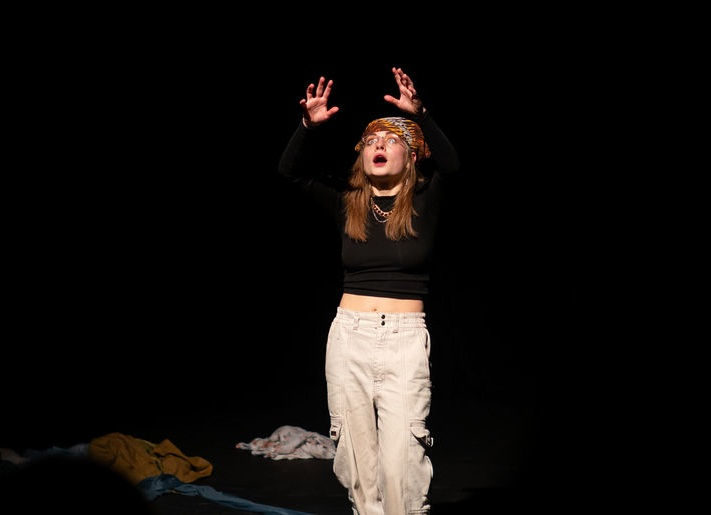
Don’t Kill Daisy
The audience ate up every minute of Soleil Kohl’s hilarious and frenetic one-hour solo triumph on closing day at Hollywood Fringe 2026. We all loved it so much, in fact, that we showed our adoration for its lead character, Daisy, by killing her — repeatedly, and sometimes quite gleefully.
Let me back up a bit before someone calls the cops.
Don’t Kill Daisy asks its audience to help keep its titular title character alive, and everyone in attendance really wants to — until they absolutely don’t — by taking two or three random props from the stage to their seats after being greeted by a mysterious yet exuberantly welcoming robed figure known as the Game Keeper. These apparently life-saving items, ranging from flowers to spy glasses, to baby dolls to a tape measure, to fake boobs, and a whole lot of yard sale-looking random stuff, are solemnly offered by the robed one as tools that might help keep the heroine alive. You see, the poor girl has a nasty habit of dying. We’re told the record from one show alone was thirty-six times.
Our unified mission is to not break that record.
And here comes Daisy herself, a classic 20-something party girl, as we meet her at Burning Man, where this modern-day hippie chick just wants to dance, dance, dance. And why shouldn’t she? She’s young, beautiful, carefree, and according to Daisy, “it’s hard for people that look like me.” Soon, however, something goes horribly wrong in the dust and heat of the desert rave, and Daisy, uh, how do we say this gently? Okay, she sort of destroys the world. And just like that, she’s also dead — hard drop to the floor, red lights enhanced, gone. The audience (thankfully still alive) moans in mock sadness, but not for long, because, like the proverbial nine lives of a cat, Daisy springs back to life, and into a new personality — a vacuous TikTok-like influencer who wants us to help her select her next stunning outfit for online glory.
Can the audience help? Of course we can. Someone in the front row had earlier collected a shimmering dress from the stage offerings, and another in the back has a glittery slip-on number. “Okay. Let’s begin,” offers the practiced product-pitcher disguised as a teen’s best friend they’ll never meet. Not for long. Red light! Daisy’s dead again. How did that one even happen?
Turns out, Daisy hits the death deck several times each performance in numerous manners of sudden demise, and most will come with a groan (and simultaneous laughter) from the audience as they fail to keep the character breathing. Soon we start to understand more about her unlucky streak as Daisy begins glitching in real time – sort of like the robot character in Alien before he begins to melt. You see, Daisy is being taken over inside-out by an evil force – Villain Daisy - who appears with increasing regularity. The Gollum-like creature is hell-bent on seeing its sweet young alter ego croak. The audience steps up as best they can, offering more life props for Daisy to choose from and fight the battle for survival. Some work, most don’t.
Death, death, death. How many is that now? We’ve already lost count.
To make matters even more challenging, the heroine has even been propped a baby to care for during all of this chaos. Great — now she has to fight off an evil force and be a mom. Daisy appeals to the crowd. Will anyone, any caring soul in the house, babysit the child so Daisy can focus on solving numerous and cosmically enormous challenges during her death/reboot cycle to save herself and the world? Crickets. Not a one. Daisy stuffs the baby down her dress.
Maybe a phone message from Future Daisy will provide some wisdom to her present-day iteration? That doesn’t work. The phone Daisy screams in pain before croaking too. Daisy then realizes that her audience might actually help in another way: by killing her themselves whenever they see something going wrong or good Daisy transforming into the evil one. A bag full of colorful kill balls is offered to the audience and we all take two or three to throw at her at the first sign of an alternate Daisy. Almost immediately, many more deaths ensue from the suddenly motivated audience themselves. Any sign of trouble and Daisy gets a barrage of rubber-round death orbs fired her way. And it doesn’t even take trouble – just a smirk or misfired joke from Daisy has the crowd mercilessly inflicting death. They love this! So much for your audience saviors, Daisy. Someone call Guinness; we might have a new record here.

For a show that has so much death, this was one outrageously funny addition to Hollywood Fringe 2026. Heading to Edinburgh soon, according to Soleil Kohl, its star and creator, the show owned the sold-out room at the Broadwater from start to finish. The gifted comedienne had her well-practiced scripted moments in fine form and also scored very nicely in improvisational moments influenced by interaction with the crowd. It was fast, funny, and fueled by the pure, unrelenting energy and quick wit of Kohl as Daisy.
Inspired by roguelite video games, digital-age obsession, and influencer-era-end-of-world chaos, Don’t Kill Daisy is ultimately a prop-driven exercise in up-close and brilliant clowning. Kohl had the arriving audience in stitches over and over as the Game Keeper, dropping to the floor repeatedly while greeting newly arriving, and quite often startled, audience members. As the crowd size grew, so did the laughs with each new arrival. Then, as Daisy, she transforms completely, nearly instantly, into her life-challenged title character and the other versions of Daisy in the wormhole of Kohl’s story.
Tech influences are never far away, as the guests can steer the show by calling out “main menu,” “dress up Daisy,” or “get a hint from the Game Keeper,” altering the direction of the participatory experience. When the inevitable final confrontation arrives with the most villainous villain - the cowboy-hat-wearing, Spaghetti-western-imbued, "fuck you" -spewing Big Bad, Daisy reveals the true inner-strength of her young heroine and wins the battle. Free of her burden, Daisy is now able to become the Game Keeper forever more. She triumphs!
As does this highlight of Fringe 2026.
Don’t Kill Daisy is a masterclass in solo showmanship. Kohl has created a bevy of Daisies that are all entertaining and wild to witness. Her character work is seamless and well-acted; each Daisy has their own sound, look, and body language that set them apart. And the over-the-top facial contortions when she’s glitching between Daisies alone was worth the price of admission. The story has an easy-to-follow hero’s-journey narrative mashed up with a loose, game-driven freeform that allows for ample audience redirect. Kohl has a charming but don’t-mess-with-me style when she breaks the fourth wall, as in one hilarious moment when she decreed the death balls were now powerless. One or two still-exuberant guests threw them nonetheless, and she quickly and quite hilariously put them in their place. Along with a delirious script, inventive improv and a pretty much flawless performance by Kohl, Daisy benefits from perfectly timed sound effects and generous music cues courtesy of audio-specialist Claire that really enhance the proceedings. Though the show's sole notable lighting cue is the red-death effect, it’s plenty to keep the recurring gag landing throughout.
The humor never relents until the very end, when Daisy offers her third-act serious moment — something we see all too often in otherwise broad comedy solo pieces. These seemingly de rigueur, earnest wrap-ups can be a bit abrupt, even out of place, and this one would certainly benefit with just a bit of trimming. It doesn’t really matter, though, because you’ve already experienced an hour of pure, unadulterated joy with the comedic genius of Soleil Kohl at the helm.
See it when you can at Edinburgh or Philly later this year. And don’t forget to keep count.
by Thom Mills


