View: The Laugh Track
The behind-the-scenes story of comedy writer Madelyn Pugh and her experiences as Lucy's "girl writer" has some early television dish but not enough primetime laughs.
An Immersive Scene Los Angeles Theatre Review

It’s a somewhat heavy lift for success when the play’s title brings with it a promise of laughter, but what’s happening on stage, notwithstanding a few moments that genuinely click, generally leaves you looking for the chance to laugh more often than getting an opportunity to. The Laugh Track, a West Coast premiere play by Wendy MacLeod, even references this very phenomenon when a character offers, “It doesn’t take a genius to make an audience laugh. They want to laugh.” True enough, but while the script delivers some smart banter and showbusiness nuggets, in the end the small-cast intimate comedy gets swallowed up on a large stage in Long Beach.
We first meet Maddie (Alli Brown) and Bob (Josh Odess-Rubin) as they bump into each other at their favorite table in their favorite Hollywood eatery, presumably in 1957. She’s alone, or trying to be, as she ponders her future after the run of I Love Lucy has just ended, and he’s chasing away the blues by chasing the skirt of some young starlet to ease the pain of sudden unemployment.
As comedy writers on the hit show, the two engage in snappy repartee, good-natured insults, and inside gossip that have given them a unified experience for the ages. And it might be ages more before they’ll get a chance to order if the world’s most inept waitress, Nellie (Alyssa Corella), doesn’t figure out where or even what a menu is.
We then flash back several years as Lucy (Jennifer Sorenson) interviews Maddie for the “girl writer” job on her soon-to-be show. For all her reputation as a purely physical comedienne, Lucy demands strong writing, “If it’s not funny, I can’t save it.” Lucy wants to make sure she’s got great material and a writer who won’t be chasing after her husband and co-star, Desi (Bill Mendieta).
Madelyn “Maddie” Pugh is hired and becomes the first prominent female writer in television. The two women now have each other to confide in within the otherwise male dominated realm. Except Lucy is the boss, and no writer’s job, regardless of sex, is ever safe if they can’t deliver, especially for a female in Hollywood’s emerging television industry where the network’s rules dictate that a woman writer must have a male partner. Bob happens to be that partner, and together with the hilarious redhead and a naturally funny Cuban bandleader, they create genius.

Studio head Harry (Hunter Bodine) wants to shoot live in New York but is convinced to film on a soundstage in L.A. by the real bosses, the husband-and-wife team known as Desilu. Over a whirlwind of time we watch the show take off, first dispensing with the overly descriptive dialogue of radio in favor of a model that is still used to this day in the modern American sitcom.
Along the way we learn about competitive writers, the machinations of network business, the loyalties and disloyalties of cast and creators, starstruck wannabes with show ideas of their own, and ultimately the innovations that made the iconic show fly, like shooting on film on a soundstage (instead of in a traditional theatre) with a live audience.
“We can keep the sets up from week to week,” offers the shrewd producer, Desi. That’s budgetary bliss to a TV exec’s ears.
The ingredients for maximum laughs are all present in this extended one-act directed by Brian Shnipper, but there’s simply not enough of them. There are, however, just enough interesting revelations to hold your interest across the ninety-minute production. Before hearing a word of dialogue, I expected the sharp banter one associates with two sparring comedy writers, and I hoped there would be opportunities for the show’s Lucy and Desi to reenact some of their famous comedy scenes. It ended up one out of two. There was plenty of the former, moderately funny when working, and almost none of the latter.
This show undoubtedly has a terrific premise: the story of one of the first female comedy writers in the all-boys-club world of early television working for the funniest woman (still to this day) in the medium. Yet the execution never matches the idea, at least on the night we attended, when the jokes never got the audience going.

The primary issue is that we’re never shown the funny Lucy. The Ball we get in The Laugh Track is mostly the serious-minded businesswoman behind the scenes, where real life doesn’t have three laughs a minute. Without iconic routines like the candy conveyor belt, Vitameatavegemin, or the grape stomping scene, the show forfeits a major source of comic energy. Instead, Shnipper must rely on Desi’s played-up English mispronunciations, and on the writers near-constant sparring. There are some laughs to be tracked, just not enough of them to carry the show.
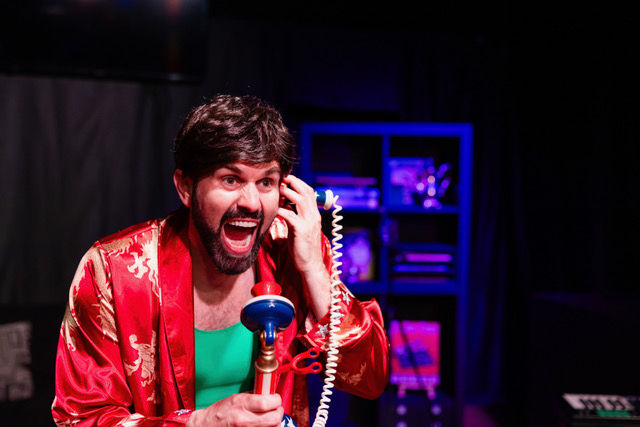
The capable cast does everything possible to serve the trip-back-in-time narrative, and each has some nice moments, with the versatile Bodine absolutely nailing four different roles with aplomb. His Harry, the network head honcho, is a hoot as he chomps on his cigar and unwittingly gives away the rights to the show and additional rerun payments to the writers because, “Who cares? Nobody wants to see the same show twice.”
As Lucy, Sorenson offers a nice portrayal of the real Lucy, not the funny one we all fell in love with as the former Ms. McGillicuddy, but the shrewd, all-business Lucille Ball. Mendieta's Desi has a likeable charm. Both Brown and Odess-Rubin offer solid performances as well, even if their sparring never reaches the comedic heights it might have. The over-the-top Nellie is no substitution for Lucy humor, but Corella goes all in with each opportunity.
Shnipper’s staging is smartly brisk with scenes snappily shifting from soundstage to restaurant to backstage, merely by actors entering and exiting or, in the case of Eddie (also Bodine), a network crony, doing an on stage semicircle in plain sight of the audience only to morph into Harry mid-stride.
The writing has its moments, with plenty of Tracy/Hepburn-style ribbing and railing between its two writers. There’s also the hint of a personal relationship that is handled nicely when the inevitable rejection occurs. The cleverest bits in MacLeod’s creation come as each character remembers things the way they want to. Bob suggests they shoot it on film rather than kinescope, but it’s quickly remembered differently and then rerun with Desi actually coming up with that concept. This motif of hazy memories repeats throughout the show.
And MacLeod pays some overdue props to the real Lucy too by writing her not as a temper-prone diva, as she has sometimes been described, but as a real human being who mentored and was respected by Maddie even as she demanded only the best from her writers.
Pugh and Carroll had an incredible fifty-year partnership – most of those years on various Lucy programs. Pugh also worked for Lucy and Desi in radio and then in vaudeville well before TV was ever in the picture. In other words, the protagonist girl writer who helped define women in TV had the gig locked long before that dramatized meeting backstage ever happened.
Perhaps in a more intimate setting this production could have soared higher. But on a huge stage in front of a quiet-ish audience, at least at this performance, it amounted to little more than mild amusement with some interesting Hollywood history. If we’d had a chance to see Lucy being Lucy Ricardo, it might have overcome its limitations. In the end, the piece is better thought of as a workplace biographical study rather than the broad comedy its title suggests. Think of it like that and you might like Lucy in this production.
International City Theatre
330 East Seaside Way
Long Beach, CA
Thru 11/220